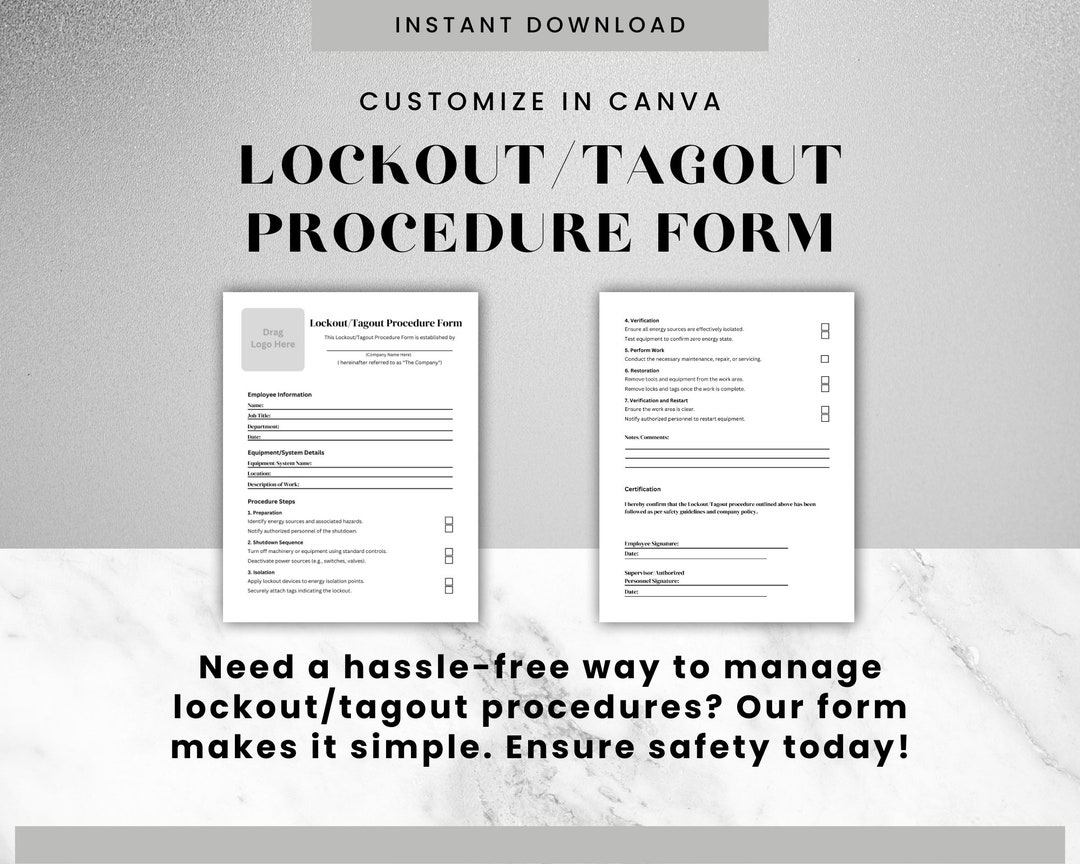
Every year, preventable accidents occur during equipment servicing—accidents that could have been avoided with a properly executed lockout tagout procedure form. Workers are injured when machines unexpectedly start up, release stored energy, or are improperly isolated. The root cause often traces back to incomplete, missing, or poorly designed LOTO forms.
A lockout tagout procedure form isn’t just a piece of paper. It’s a documented, step-by-step plan that ensures machines are safely shut down, isolated from energy sources, and secured against unauthorized re-energization. Whether you’re managing maintenance in a manufacturing plant, overseeing facility operations, or handling machinery in a warehouse, the LOTO form is your frontline defense against catastrophe.
This guide dives into what makes a LOTO procedure form effective, how to build one correctly, and where most organizations fall short.
What Is a Lockout Tagout Procedure Form?
A lockout tagout procedure form is a standardized document that outlines the exact steps required to safely de-energize and secure machinery or equipment before maintenance or servicing. It specifies energy sources, required lockout devices, verification steps, and personnel responsibilities.
Unlike general safety policies, this form is task-specific. It’s not a one-size-fits-all template but a tailored procedure for a particular machine or system.
For example, a hydraulic press in a metal fabrication shop has different energy hazards (hydraulic pressure, electrical circuits, mechanical springs) than a conveyor system in a packaging facility (electrical motors, gravity-driven rollers, pneumatic actuators). Each needs its own LOTO form.
These forms serve multiple critical functions: - Ensure all energy sources are identified and isolated - Provide clear instructions for authorized employees - Document compliance with OSHA 29 CFR 1910.147 - Reduce human error during high-risk tasks
Without a proper form, even experienced technicians can overlook a residual energy hazard—like a charged capacitor or pressurized line.
Key Components of an Effective LOTO Procedure Form
A high-quality lockout tagout procedure form isn’t just a checklist. It’s a detailed roadmap to zero-energy state. Here’s what must be included:
1. Equipment Identification Clearly state the machine name, ID number, location, and any visual reference (photo or diagram). Ambiguity kills—“Pump A” is not enough. Use “Raw Water Feed Pump #3 – North Processing Line.”
2. Energy Source Inventory List every energy type present:
- Electrical (voltage levels)
- Hydraulic (pressure, fluid type)
- Pneumatic (air lines, pressure)
- Mechanical (springs, gravity, inertia)
- Chemical (pressurized tanks, reactive agents)
- Thermal (steam lines, heated surfaces)
Each source must be addressed in the isolation steps.
3. Step-by-Step Isolation Sequence Outline in order:
- Normal shutdown procedure
- Isolation of each energy source (e.g., open disconnect switch, close valve)
- Application of lockout devices (lock type, location)
- Application of tagout (tag content, responsible person)
- Release of stored energy (bleed lines, block moving parts)
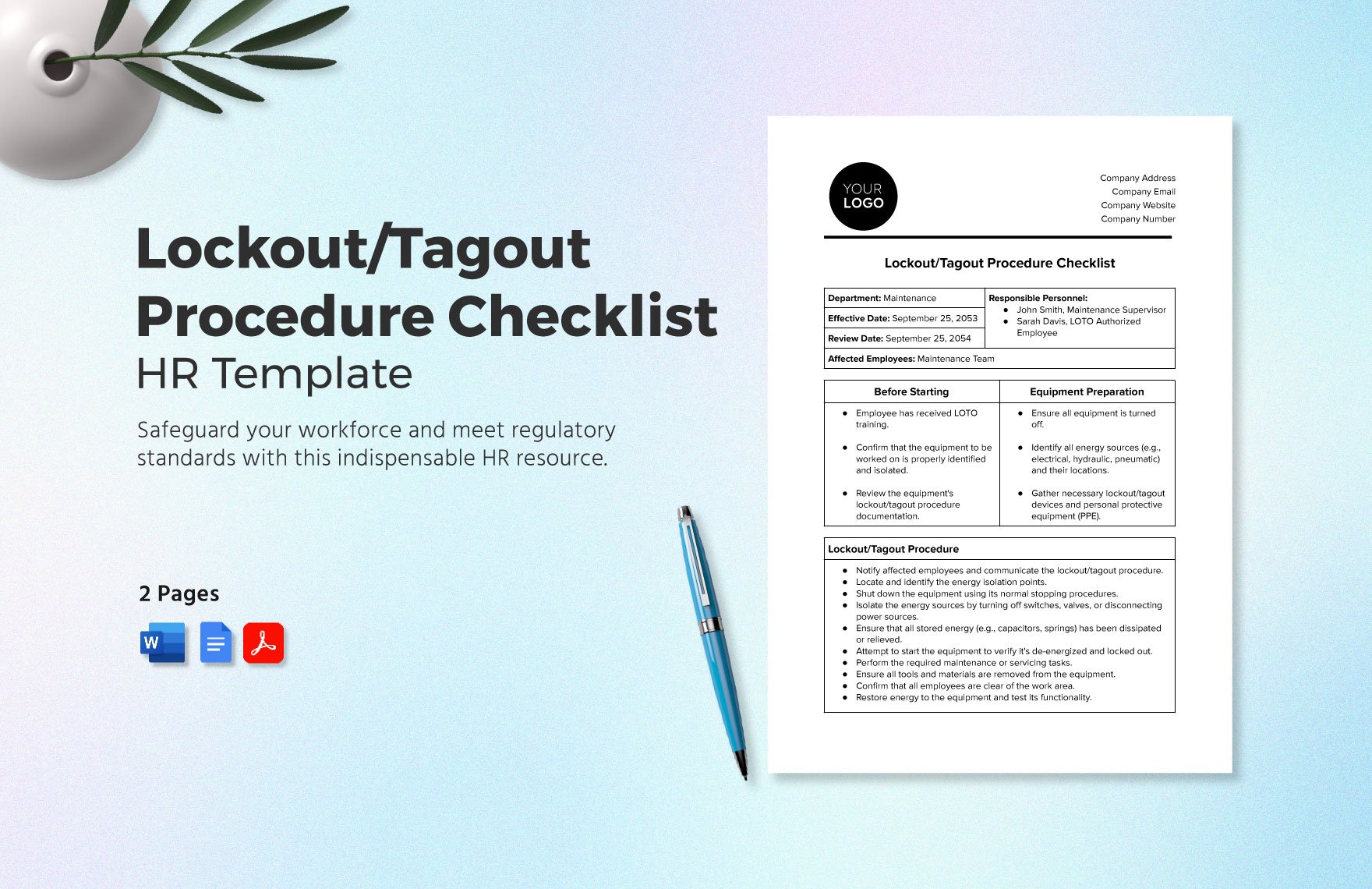
- Example:
- Shut down CNC lathe via control panel.
- Open main 480V disconnect switch.
- Apply personal lock #LT-042 (John Doe).
- Close and lock hydraulic supply valve.
- Bleed pressure from accumulator via test port.
- Verify zero energy using voltage tester and pressure gauge.
4. Verification of Isolation
This is non-negotiable. The form must require a “tryout” step—attempting to start the machine after lockout to confirm it won’t energize.
Note: This is done after ensuring no one is in danger and only by the authorized employee.
5. Personnel Accountability Include space to list:
- Name and ID of the authorized employee applying locks
- Names of affected workers notified
- Time and date of lock application
- Clearance signature upon completion
6. Release and Re-Energization Procedure Detail how and when locks are removed:
- Confirm all tools removed
- Verify all employees are clear
- Unlock in reverse order of application
- Notify operations team
- Document completion
Why Most LOTO Forms Fail in Real-World Use
Many companies have LOTO forms that look good on paper but fail under pressure. Here’s where they break down:
Incomplete Energy Source Mapping A form for a packaging machine lists electrical but ignores compressed air used to actuate clamps. During service, a technician releases a latch—triggering a sudden movement. Cause? Unreleased pneumatic energy.
Fix: Conduct an energy audit for each machine. Involve maintenance techs—they know where hidden hazards live.
Vague or Generic Instructions Phrases like “isolate power source” or “secure machine” leave too much to interpretation. Which disconnect? What kind of lock?
Fix: Be specific. Use diagrams, lock IDs, and exact switch names.
Lack of Verification Steps Some forms skip the “tryout” phase. Technicians assume the machine is dead because the switch is off. But what if the disconnect failed?
Fix: Require verification with test instruments. Document results.
No Multi-Employee Coordination Plan In group lockout scenarios, forms often don’t specify who removes which lock or how communication is maintained.
Fix: Use a group lockout box. Each technician applies their own lock. The last person to finish removes the final lock after confirming all others are clear.
Poor Accessibility Forms locked in a manager’s office or stored in a digital system with no offline access delay response during breakdowns.
Fix: Keep laminated forms at or near the machine. Use QR codes linking to digital versions.
When to Use a Standard Template vs. Custom Procedure
While templates speed up development, they shouldn’t replace custom procedures.
Use a template when: - Creating your first LOTO program - Training new safety officers - Standardizing formatting across departments
Always customize when: - Deploying to specific equipment - Addressing unique energy hazards - Meeting site-specific workflows
For example, a boiler maintenance procedure must account for steam pressure and water level, while a robotic arm procedure must address servo motor capacitors and emergency stop circuits.
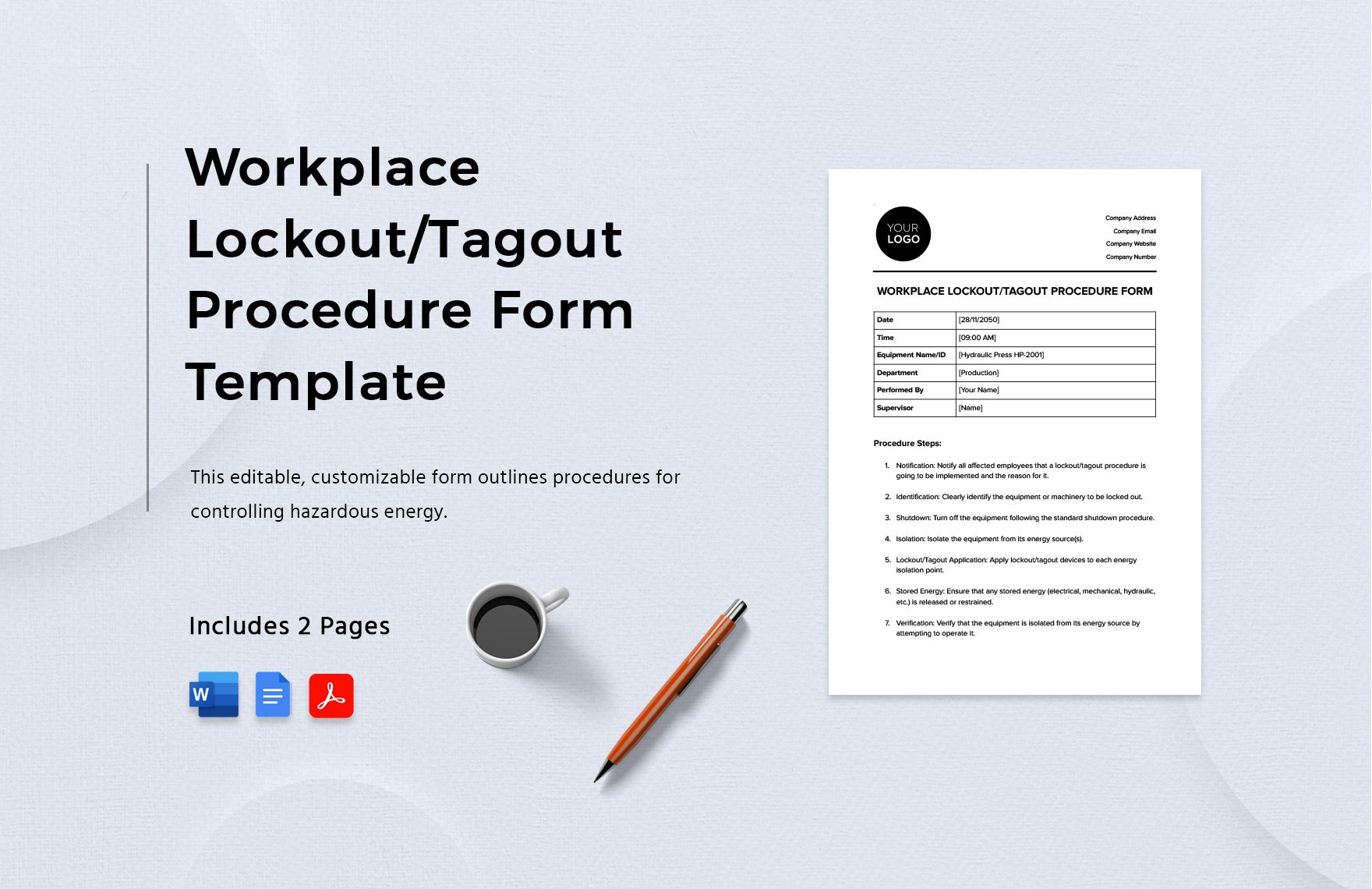
Over-reliance on generic forms leads to gaps. A study by the National Institute for Occupational Safety and Health (NIOSH) found that 60% of LOTO-related incidents occurred when standard procedures were applied without adaptation.
5 Realistic Use Cases for LOTO Procedure Forms
1. Conveyor Belt Repair in a Distribution Center Hazard: Gravity-fed rollers can shift unexpectedly. Form Focus: Mechanical lockout of drive pulley, blockage of rollers, verification of slack.
2. Electrical Panel Maintenance Hazard: Capacitors retain charge after power-off. Form Focus: Discharge procedure, voltage testing, arc flash PPE notation.
3. Tank Cleaning in a Chemical Plant Hazard: Residual vapors and pressure. Form Focus: Venting sequence, gas monitoring, isolation of inlet/outlet valves.
4. Replacing a Hydraulic Cylinder Hazard: Stored pressure in lines and cylinder chamber. Form Focus: Bleed valves, lockout of directional control valve, mechanical blocking.
5. Servicing an Overhead Crane Hazard: Uncontrolled movement, counterweight drop. Form Focus: Rail lockout, hoist brake verification, trolley blocking.
Each case demands a tailored form—no shortcuts.
Common Mistakes That Invalidate Your LOTO Form
Even small errors can nullify the legal and safety value of your procedure.
- Using blank tags – Tags must include name, department, reason, and date.
- Skipping group lockout protocols – One person shouldn’t remove all locks in a team job.
- No revision date – Old forms with outdated equipment IDs create confusion.
- Assuming one form fits all models – Two identical-looking machines may have different control systems.
- Failing to train affected employees – Operators must know not to bypass locks or remove tags.
One manufacturing plant faced a $150,000 OSHA fine because their LOTO forms didn’t include stored energy release steps—even though the policy existed, the forms didn’t reflect it.
Documentation must match practice.
How to Build and Maintain a Reliable LOTO Program
A single form is not enough. You need a system.
- Audit all equipment – Identify every machine requiring LOTO.
- Develop individual procedures – One form per machine or system.
- Train authorized and affected employees – Annual retraining is mandatory.
- Conduct annual inspections – Watch someone perform the procedure and verify compliance.
- Keep forms updated – Revise when equipment is modified or relocated.
- Store securely but accessibly – Use binders, wall stations, or digital kiosks.
Digital LOTO management systems are rising in popularity, offering version control, mobile access, and audit trails. But even paper forms work—if they’re accurate, available, and followed.
Final Thoughts: Your LOTO Form Is a Lifesaving Document
A lockout tagout procedure form isn’t compliance paperwork. It’s a field manual for survival. When done right, it eliminates guesswork, protects lives, and ensures maintenance happens without incident.
Don’t treat it as a box-ticking exercise. Review it. Test it. Improve it.
Start today: Pick one high-risk machine. Audit its current form. Walk through every step. Ask: “Would this prevent an accident?” If not, revise it now.
Safety isn’t guaranteed by policy alone—it’s enforced by precision, discipline, and documentation.
Frequently Asked Questions
What should a lockout tagout procedure form include? It must list equipment details, all energy sources, step-by-step isolation, verification methods, personnel roles, and re-energization steps.
Who can create a LOTO procedure form? Authorized employees with technical knowledge of the equipment, typically in collaboration with safety officers.
Do all machines need a LOTO form? Yes, if they have potentially hazardous energy sources and require servicing where unexpected startup could cause injury.
Can a LOTO form be digital? Yes, as long as it’s accessible at the point of use, tamper-proof, and includes all required elements.
How often should LOTO forms be reviewed? At least annually, or whenever equipment is modified, relocated, or involved in a near-miss.
What’s the difference between a LOTO form and a tag? The form is the full procedure. The tag is a warning label applied during lockout, showing who locked it and why.
Can one person perform lockout for multiple machines? Yes, but each machine must have its own completed form and proper isolation—never assume one lock covers all hazards.
FAQ
What should you look for in Lockout Tagout Procedure Form Essentials for Safety? Focus on relevance, practical value, and how well the solution matches real user intent.
Is Lockout Tagout Procedure Form Essentials for Safety suitable for beginners? That depends on the workflow, but a clear step-by-step approach usually makes it easier to start.
How do you compare options around Lockout Tagout Procedure Form Essentials for Safety? Compare features, trust signals, limitations, pricing, and ease of implementation.
What mistakes should you avoid? Avoid generic choices, weak validation, and decisions based only on marketing claims.
What is the next best step? Shortlist the most relevant options, validate them quickly, and refine from real-world results.